Audience
The Certified Tester – Finance Testing certification is aimed at professionals involved in software testing or quality assurance within financial institutions, fintech companies, regulatory bodies, or organizations delivering software for the financial services industry. This includes testers, test analysts, test automation engineers, test managers, business analysts, developers, compliance officers, auditors, regulators, and IT risk, security, or operations professionals.
The certification is useful for anyone who wants to gain a deeper understanding of how testing supports financial regulations, risk management, data accuracy, security, performance, auditability, and automation in financial systems. Candidates who complete the course and exam will be better prepared to contribute to testing activities in regulated financial projects and to communicate effectively with business, compliance, audit, technical, and risk stakeholders.
The ISTQB® Certified Tester Foundation Level (CTFL),v4.0 or previous versions, is a prerequisite for the CT-FT certification.
Content
The Certified Tester - Finance Testing Certificate exam will be based on this syllabus. Answers to exam questions may require the use of material based on more than one section of this syllabus. All sections of the syllabus are examinable, except for the Introduction and Appendices. Standards and books are included as references, but their content is not examinable, beyond what is summarized in the syllabus itself from such standards and books.
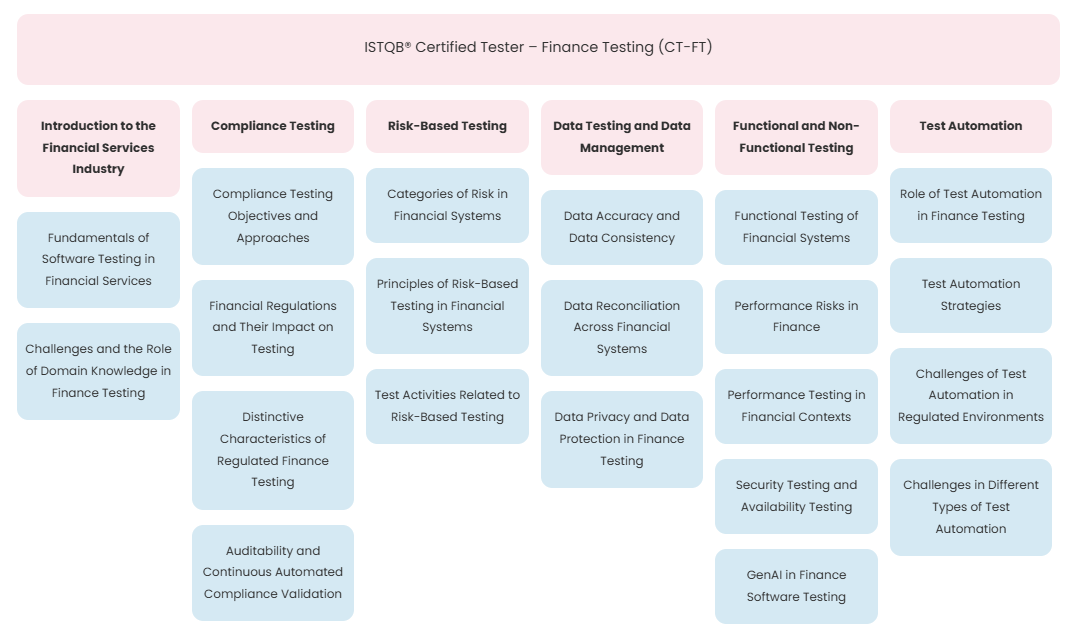
- Chapter 1:Introduction to the Financial Services Industry – (50 minutes)
- Chapter 2:Compliance Testing – ( 80 minutes)
- Chapter 3:Risk-Based Testing – ( 45 minutes)
- Chapter 4:Data Testing and Data Management – ( 90 minutes)
- Chapter 5:Functional and Non-Functional Testing – ( 165 minutes)
- Chapter 6:Test Automation – ( 105 minutes)
Business Outcomes
A candidate who has achieved the Finance Testing certification should be able to:
- Understand the structure of the financial industry, its institutions, systems, and processes, and explain the specific challenges of testing within this domain.
- Apply testing practices that support compliance with financial regulations and standards, ensuring auditability, traceability, and documentation requirements are met.
- Apply risk-based testing approaches to financial systems, prioritizing testing activities according to business, technical, and regulatory risks.
- Understand test practices that ensure data accuracy, consistency and protection across financial systems, including the use of masking and anonymization techniques.
- Apply functional and non-functional test techniques in the financial domain, with particular emphasis on performance, reliability, and security.
- Understand the role of test automation in financial environments and apply automation strategies effectively in both legacy and modern systems, while considering regulatory constraints.
Exam model
To gain this certification, candidates must hold the Certified Tester Foundation Level certificate.
Test includes (Please click here to download the relevant information)
- The exam is comprised of 40 multiple-choice questions.
- Total score: 45 points. Exam takers will need 30 points in order to pass the Exam.
- Exam Length (mins):60 minutes.For non-native speakers who have applied in advance and been approved for a 25% extension, the exam length is 75 minutes.